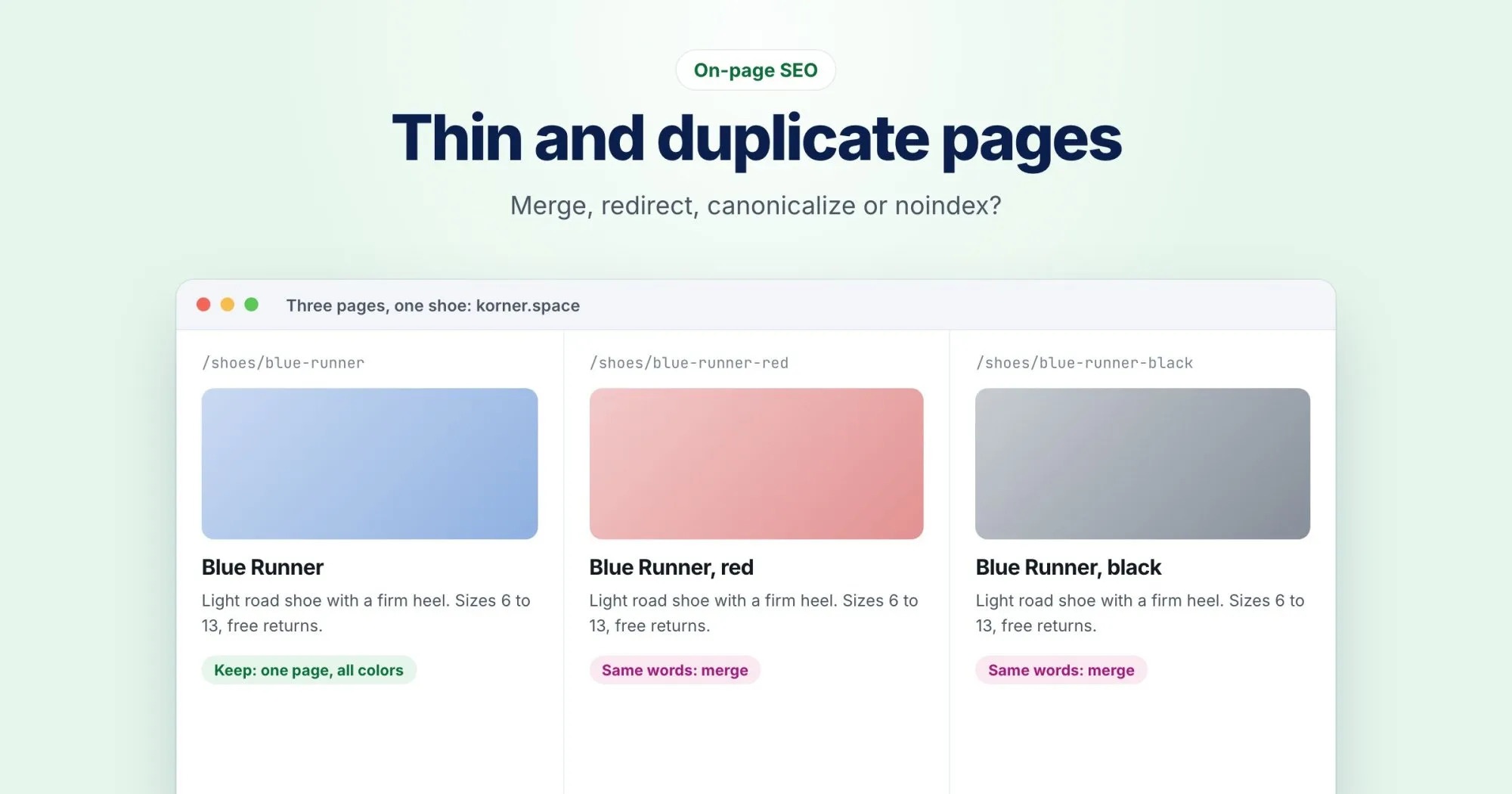
Imagine korner.space sells a trail running shoe in five colors, and each color has its own page. The photos differ. The 400 words of description, the size chart and the reviews are identical. To a search engine that's five pages competing for the same searches, each with a fifth of the signals one page could have had.
Most sites collect pages like this without anyone deciding to. The fix is rarely "delete them all". It's picking the right tool for each kind.
The four tools, briefly
- Merge and 301 redirect. Combine the content into one page and permanently redirect the others to it. The old URLs stop existing; their links and history follow the redirect.
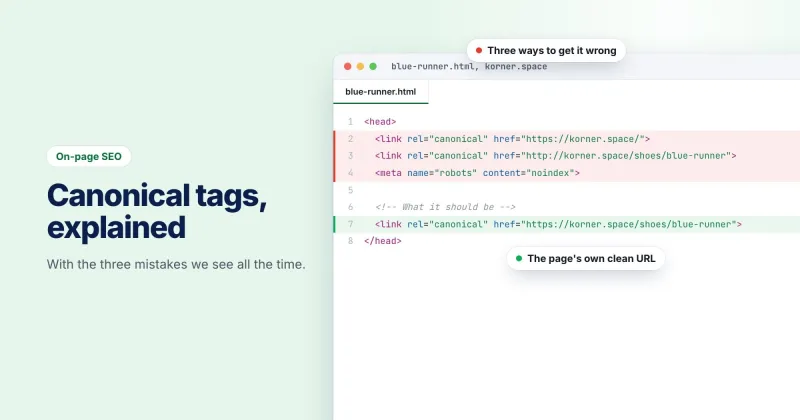
- Canonical. Keep every URL working for visitors, but tell search engines which one to index. It's a hint rather than a rule. My post on canonical tags covers how it goes wrong.
- Noindex. Keep the page for visitors and leave it out of search entirely.
- Remove with 404 or 410. The page has no value and no replacement. A 410 says it's gone on purpose.
A decision table
| The page | Does it help visitors? | Does it deserve to rank on its own? | Use |
|---|---|---|---|
| Color variant of the same shoe | Yes | Usually not | Canonical to the main product page |
| Color variant people actually search for by name | Yes | Yes | Keep it indexable, and make the page genuinely different |
| Tag page with two posts on it | Barely | No | Noindex, or remove the tag |
| Filtered list, such as desks under $300 sorted by price | Yes | No | Canonical to the unfiltered category |
| Ten city pages with only the city name swapped | No | No | Merge into one page, 301 the rest |
| Three short posts on the same topic from 2019 | Partly | Not separately | Merge into one updated post, 301 the others |
| An old announcement nobody visits or links to | No | No | 410 |
Tag and filter pages
Tags are cheap to create, so blogs end up with hundreds of them, most holding one or two posts. A tag page with real depth, say fifteen posts on standing desk ergonomics, can be worth indexing. The rest are better off with noindex, or simply merged into a broader tag.
Location pages that only swap the city
"Standing desks in Austin" and "Standing desks in Denver" with identical text are exactly what Google's spam policies describe as doorway pages. If korner.space ships everywhere from one warehouse, one shipping page says it all. Location pages only earn their keep when they carry something local: a showroom address, opening hours, delivery times that actually differ.
Old short posts
Three 250 word posts from different years about choosing desk height are weaker than one thorough guide. Merge the useful parts into whichever post is strongest, update it, and 301 the other two to it.
Which URL to keep
When you merge, keep the URL that has the most going for it already: the most links from other sites, the most search traffic, the cleanest address. Check your backlink tool and Search Console first. Redirecting a well-linked page into a newer, weaker one throws away the easy part.
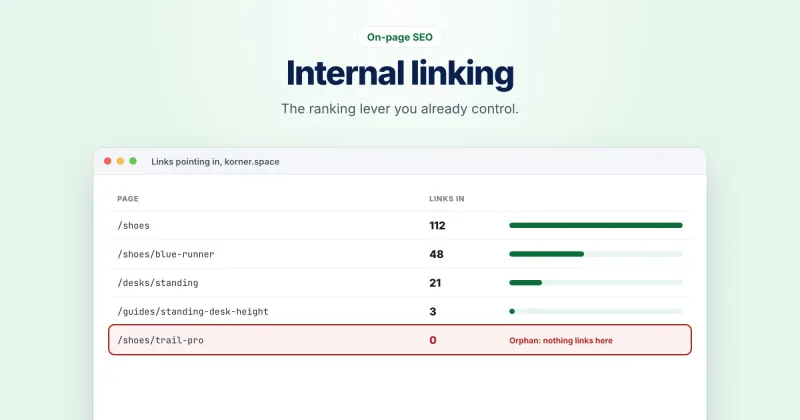
Then update your internal links to point straight at the survivor, and take the redirected URLs out of your sitemap. If you're redirecting a URL that already redirects, collapse it to a single hop.
Noindex, canonical or 410?
A simple test: if a visitor should still be able to reach the page, use canonical when it duplicates another page and noindex when it's just not search-worthy. If nobody needs it, remove it. Don't block these pages in robots.txt, because a crawler that can't fetch a page never sees its canonical or its noindex. And for removals, make sure the server really returns the error code; a blank page with a 200 is a soft 404.
Finding them
Pages that share a title are usually near-duplicates of each other. A WebRankPage site crawl, on the Agency plan, counts pages that share a title or a meta description, and every report flags pages with too few words to say much. Sort what it finds into the table above.